
A growing body of extensive research has shown that nature and outdoor play support early childhood education by shaping how children think, feel, and understand the world. Time spent in nature and playing outside, supports young children’s development across key areas including physical development, sensory learning, emotional wellbeing, and creative expression.
How Children Learn
Children do not learn best by sitting still or by being told information, young children learn easily and naturally when they are:
- Moving their bodies, such as, running, crawling, balancing, carrying and climbing.
- Using their senses, such as smelling, observing, touching, tasting and listening.
- Exploring with freedom, by experimenting, discovering cause and effect, following curiosity and repeating experiences in order to understand them.
- Playing, through trial and error, problem solving. Making meaning through imagination. Interacting and responding to what is real, alive and unpredictable in their environment.
Why Outdoor Play Matters
Nature invites children to explore with all their senses, to move freely and develop a deep sense of curiosity and wonder creating a strong foundation for quality early childhood education. Schools that encourage outdoor play, allow children the freedom to imagine, problem-solve, and create their own games. Without fixed rules or single-purpose toys, children are not limited by desks or walls. Sticks become tools, stones can be counted or stacked, mud can be mixed, and uneven ground challenges balance and coordination. In this way, the environment itself becomes the teacher.
Outdoor play supports early education for children by nurturing emotional wellbeing as well as learning. Playing outside can help children feel calmer, more confident, and better able to manage their emotions. By smelling the sea, or feeling the sun, these experiences help the brain form strong, lasting connections. Through these real-world experiences, children develop a sense of wonder, respect for their environment, and a meaningful connection to learning.
Building Strong Bodies Through Movement

Gross motor development refers to the skills children use to control their large muscles. The muscles needed for walking, running, balancing, jumping, and climbing. In early childhood these skills develop best through active, whole-body movement rather than structured exercises.
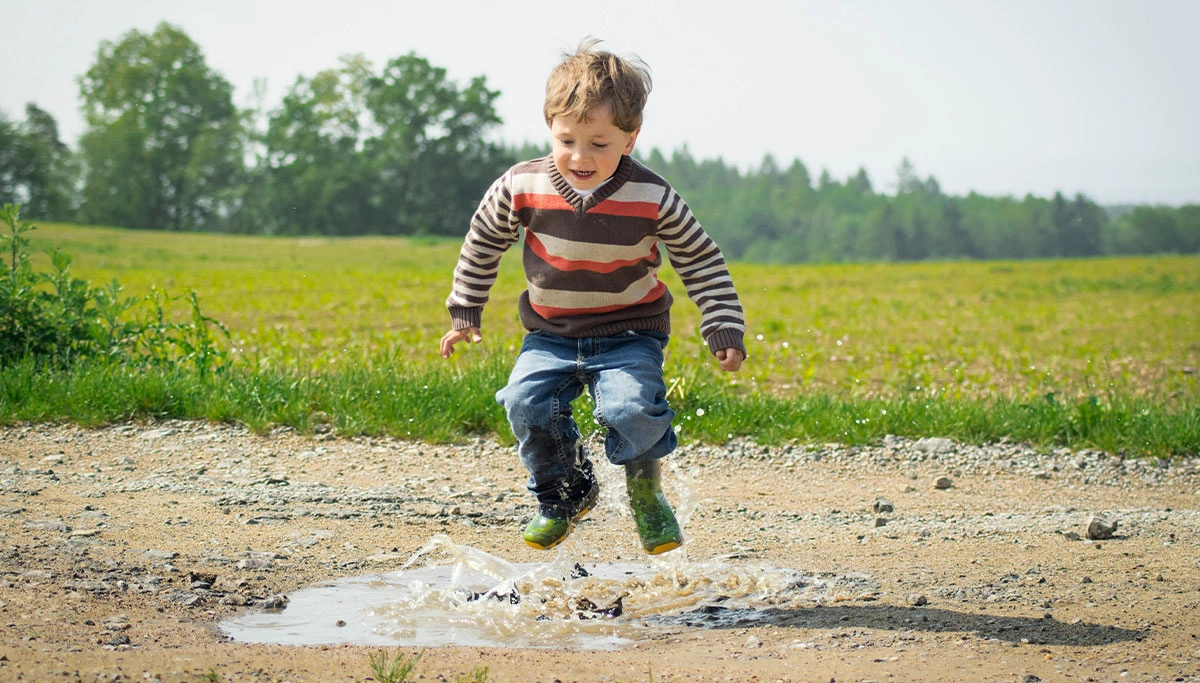
Nature-based play environments offer endless opportunities to develop coordination, balance, and body control. When children run, climb trees, balance on logs, and jump over puddles, they engage large muscle groups and learn to move with purpose and control. Navigating uneven ground strengthens core muscles and improves coordination.
These repeated movements help children build muscle tone, bone strength, and cardiovascular endurance. Because the movements are self-directed and playful, children are more likely to stay active for longer periods, developing stamina without pressure or fatigue. Over time, this regular physical activity supports healthy growth and establishes positive movement habits early in life.
Playing in nature provides the space, freedom, and variety of movement that indoor environments often cannot. Open areas and natural obstacles encourage children to challenge their bodies and build strong foundational movement skills that support health, confidence, and lifelong physical wellbeing.
As children master new physical challenges, they develop confidence and resilience. Each successful climb, jump, or balance attempt reinforces a sense of achievement and encourages them to try again, supporting both physical development and emotional wellbeing.
Body Awareness
Outdoor play also supports body awareness. Children learn where their bodies are in space, how much force to use, and how to adjust movements to different environments. These repeated movements are a key benefit of outdoor play for children, helping build muscle tone, bone strength, and overall coordination. Because the movement is self-directed and enjoyable, children stay active longer and develop stamina naturally.
Sensory Exploration Through Outdoor Play
Sensory exploration is a vital part of early childhood education, and nature provides rich sensory experiences that indoor environments cannot replicate. Outdoors, children feel different textures like grass, sand, bark, and water. They hear birds and rain, smell flowers and earth, and experience changes in light, temperature, and weather.
These sensory experiences strengthen brain development, support language growth, and help children make sense of the world. Sensory-rich outdoor play can also help children regulate emotions, feel calmer, and engage more deeply in learning and social interactions.
Creativity and Imagination in Nature-Based Play

Nature encourages creativity by offering open-ended materials and endless possibilities. Without toys that dictate how they should be used, children create their own ideas, stories, and games. A stick might become a magic wand, a bridge, or a fishing rod. Leaves and stones can be sorted, patterned, or used in imaginative play.
This type of creative play supports problem-solving, flexible thinking, and self-expression all of which are key elements of effective early childhood education. When children are free to imagine and create, they build confidence in their ideas and develop a lifelong love of learning.
How Educators Can Integrate Nature into Early Childhood Education
Educators play an important role in creating meaningful opportunities for children to learn through nature. By intentionally incorporating outdoor play into the daily routine, teachers can support physical development, sensory learning, creativity, and emotional wellbeing. This can include:
- providing time for free outdoor play
- using natural materials for learning activities
- encouraging exploration and curiosity
- allowing children to move, observe, and interact with their environment
When outdoor experiences are thoughtfully planned and guided, nature becomes an extension of the classroom and a powerful learning tool.
At Providence Children’s Academy, nature-based learning and outdoor play are woven into the preschool experience to support children’s development in a balanced and holistic way. Through purposeful outdoor experiences, children build confidence, focus, and a love of learning that prepares them for future schooling.
To learn more about how Providence Children’s Academy supports early childhood education through play and nature, we invite you to arrange a tour of our facility by calling 954-570-6914 or using our online contact form.